Colorado Barn Design
Equestrian Style Takes the Reins

Photo Courtesy of Corey Anthony
Sir Winston Churchill is often credited for having said, “The outside of a horse is good for the inside of a man.” Assumed to refer to the rigors and character-building aspects of horsemanship, the quote might also apply to the aesthetic of horses, and all the trappings that come with them.
Equines have long been featured prominently in art, from prehistoric cave paintings in France to Franz Marc’s expressionist blue horses. Nowadays, it’s easy to find horsebit-emblazoned everything—and wool coolers sold as throw blankets—from equestrian-heritage brands like Hermes and Gucci. Not to be outdone, fashion houses that never had anything official to do with the equestrian world, like Chanel, send horses down the catwalk.

Photo Courtesy of Angella Crabb
With 2026 being the Year of the Horse in Chinese astrology, the imagery seems even more ubiquitous. This spring, Denver-based writer Kathryn O’Shea-Evans (who penned Anthropologie’s best-selling book Alpine Style) released her grand love letter to horses, Horse Country. She points to what she calls “the Instagram Effect” for the upswell in equestrian interest: Horses “are just so incredibly beautiful. They don’t need any AI or filters. But also, I think that we are returning to our roots, whether that’s baking bread or growing flowers or having a horse. I think it’s almost like a primal thing that people are finding important right now to sort of balance all of the other craziness.”
O’Shea-Evans is a self-proclaimed “ascendant equestrian” whose familiarity with horses may be new, but her passion for them is not. Beginning with her 40th birthday a few years ago, she gave herself the gift of saddling up weekly for lessons with a big chestnut named Redford. “I adore the grooming,” she says. “That’s actually my favorite part. It’s better than getting my own spa treatment, and then the riding itself—it feels a bit like you’re flying, and I love bareback riding. You feel like you’re part of the animal, you can feel every muscle underneath you, and it’s just amazing.”

Photo Courtesy of Corey Anthony
Horse Country’s imagery spans the globe, from behind the scenes at stateside horse shows and rodeos to details of elaborate tack and costumes from far-flung lands. O’Shea-Evans’ essays and odes to all things horse are peppered among close-ups of historic attire, sweeping backdrops of bluegrass splendor and enviable equestrian properties. An illustrated dictionary of breeds introduces some that even the most learned 10-year-old Pony-Clubber has yet to find out about.
O’Shea-Evans says equestrian style—the severe riding habits of foxhunting and dressage, the leather, brass, wool and horsehair that are the hallmarks of the look—are evergreen. “It’s almost like a man’s tuxedo. It’s a constant. The tux my great-grandfather wore and the saddle he rode in are nearly the same as what we find today. They are eternal. They cannot be improved upon.”

Photo Courtesy of Corey Anthony
Denver-based interior designer Joei McIntire agrees. “I think it’s so timeless. It’s so classic. It’s so Ralph Lauren. That never really disappears,” she says. Her latest project could very well be considered her “first rodeo,” however, with both equestrian style décor and the fact she was designing for hoofed clients, designing a dreamy Greenwood Village barn became one of her favorite projects.
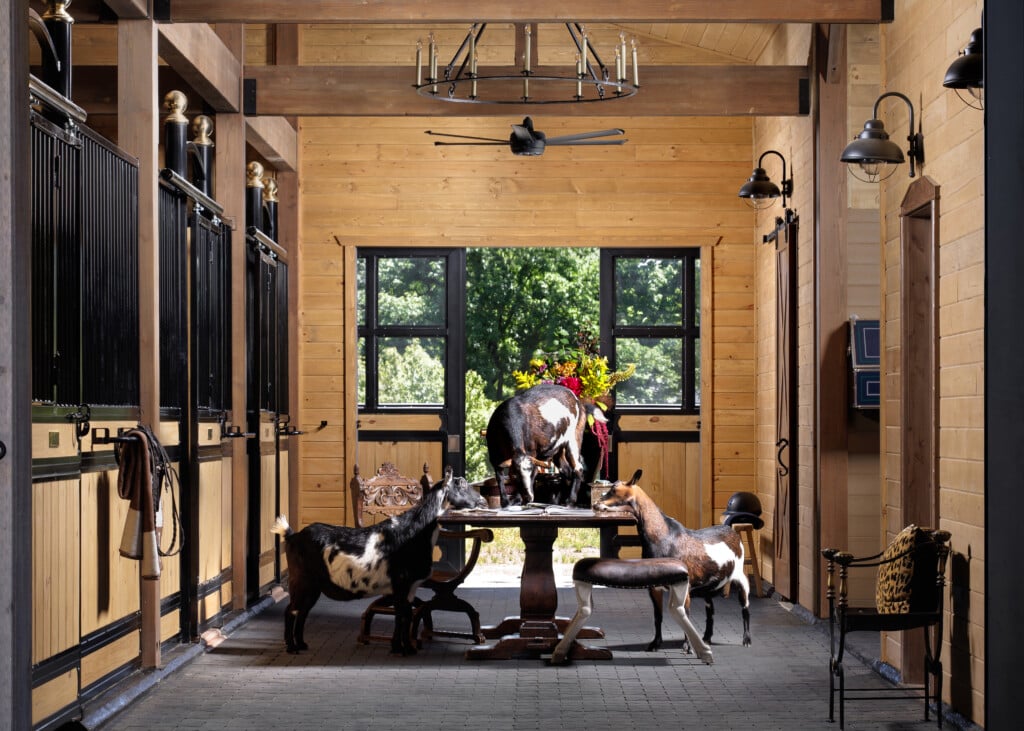
McIntire’s client came to her with the idea of designing a barn to house her retired hunter-jumpers. In keeping with the home’s architecture, the barn is modern Craftsman in style. She says her client’s taste leans toward modern, so going full-blown English equestrian took a little encouragement. “She said, ‘I don’t know, but I trust you,’” the designer recalls.
The barn contains three stalls, each with a run, as well a wash rack, feed room, hay storage and a tack room that doubles as a lounge. It’s as elegant as it is workable. Mulberry plaid wallpaper adorns the vaulted ceiling, which is anchored by a gleaming brass-and-leather Ralph Lauren chandelier.

Photo Courtesy of Corey Anthony
The custom cabinetry, painted a muted green, hides pull-out drawers and roll-out shelves that store blankets, saddle pads and leg wraps. Saddles and bridles are beautifully displayed on hooks above.
McIntire says designing for equine residents provided a fun challenge for her team. She had the client bring home saddles and bridles so they could get correct measurements of how the tack actually hangs: “How many saddles can we fit and have a nice amount of space so she (the client) can grab them off and be able to put them back on without hitting another one?”
The team focused on making the design intuitive and stress-free, asking questions such as, “How do they walk in the door? Where do their boots go? Where does the bridle go? How far do you have to walk to put the saddle away? How far do you have to go to get the horses’ feed?” Says McIntire, “It is really about understanding the functionality.

Photo Courtesy of Corey Anthony
“I think that people are spending a lot more time at their homes and the places that make them happy, and investing in those spaces that they see every day … This client lives and breathes horses. It’s what makes her happy.”
McIntire’s equestrian education may not have inspired her to sit in a saddle quite yet, but she says, “I’m over there quite a bit and I’ll still go in and say hi to the horses. It just is so crazy how much personality they have!”
For O’Shea-Evans, the equestrian journey continues. “I’m so blessed to be able to do it. It’s definitely in my blood, and I feel like a return to something very primal when I’m around horses,” she says. “I just feel instantly chillaxed. It doesn’t matter what day I’ve had or the stress at work. I’ve never had a Xanax, but I would imagine that’s what it’s like!”